The Deflation Engine: How Continuous Improvement Compounds into Economic Transformation
How Deming fits in the modern world

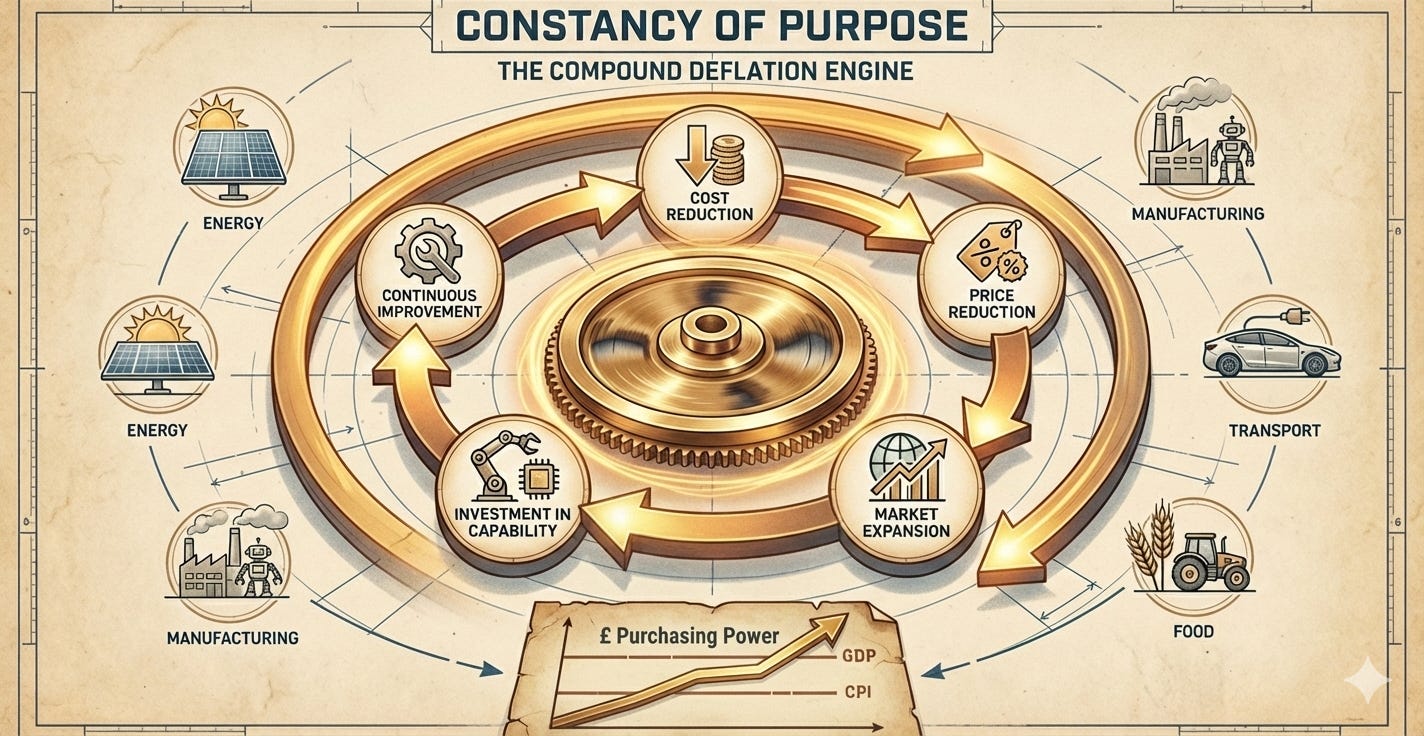
We’ve explored Deming’s System of Profound Knowledge across six posts: systems thinking, understanding variation, theory of knowledge, psychology, and Tesla’s modern vindication. Now we connect these manufacturing principles to a broader economic thesis: compound deflation.
This is where 40 years of manufacturing experience meets economic analysis. Deming’s principles don’t just create competitive advantage for individual companies - applied systematically across industries, they create deflationary pressure that transforms entire economies whilst appearing as decline in traditional metrics.
What Is Compound Deflation?
I’ve developed a thesis (start here) that simultaneous cost reductions across energy, transport, labour, and food will create sustained deflationary pressure over the coming decades. This won’t feel like the deflation economists fear (depression, falling demand). Instead, it will manifest as:
Living standards rising whilst GDP growth appears modest
Purchasing power increasing faster than wage growth suggests
Core necessities becoming cheaper relative to income
Traditional economic metrics missing the improvement
One source of this deflation - often overlooked - is manufacturing productivity improvements driven by systematic continuous improvement. Not dramatic breakthroughs, but patient, systematic application of principles like Deming’s, compounding over decades.
This is the deflation engine: Continuous improvement → cost reduction → price reduction → market expansion → further improvement → compound effect.
The Mathematics of Compound Improvement
Consider two manufacturers:
Company A (Traditional):
Sporadic improvement efforts
Cost-cutting programmes when profits sag
No systematic continuous improvement
Year 1 costs: 100
Year 10 costs: 95 (5% reduction over decade from efficiency gains and scale)
Year 20 costs: 90
Company B (Deming):
Systematic PDCA cycles
Understanding and reducing variation
Building quality in
Removing barriers
Year 1 costs: 100
Year 2 costs: 98 (2% reduction through systematic improvement)
Year 3 costs: 96.04 (2% reduction compounds on Year 2 base)
Year 10 costs: 81.7 (cumulative 18.3% reduction)
Year 20 costs: 66.7 (cumulative 33.3% reduction)
The gap: After 20 years, Company B’s cost structure is 26% lower than Company A (66.7 vs 90). This is an insurmountable competitive advantage.
In reality, the gap is often larger because:
Learning accelerates (better understanding enables faster improvement)
Improvements build on each other (reduced variation enables tighter tolerances, enables better quality, enables premium pricing, enables investment in capability...)
Culture compounds (people who’ve done continuous improvement for 20 years are much better at it)
Toyota: 70 Years of Compound Improvement
Toyota’s journey from post-war rubble to automotive dominance illustrates the compound deflation engine perfectly.
1950s:
Applied Deming’s teachings systematically
Developed the Toyota Production System
Focus on eliminating waste, reducing variation
Cost improvements modest but consistent
1960s-70s:
Improvements compound
Cost structure significantly better than competitors
Quality reputation builds
Market share grows in Japan
1980s:
Cost and quality advantages insurmountable
Conquest American market
“Japanese Quality” becomes gold standard
Competitors scramble to copy
1990s-2000s:
Continue improving whilst competitors stagnate
Hybrid technology (Prius) - long-term capability investment
Manufacturing excellence enables product innovation
The gap widens further
2010s-2020s:
Dominant in automotive quality and efficiency
Competitors are still trying to catch up to 1990s Toyota
70 years of patient improvement creates a moat
The deflation effect:
The real cost to produce a Toyota in 2020 vs 1950 (adjusted for capability) is dramatically lower
Quality dramatically higher
Productivity per worker is orders of magnitude higher
Prices haven’t risen proportionally to capability gains
Purchasing power for consumers increased
This didn’t happen through dramatic breakthroughs. It happened through patient, systematic, never-ending improvement. 2% per year for 70 years is transformational.
Tesla: Compound Improvement at Unprecedented Speed
From Post 6, we saw how Tesla applies Deming’s principles comprehensively. The deflation engine is clearly visible:
2012-2015: The Model S Era
Establish manufacturing capability
Cost per vehicle: High (low volume, learning)
Build systems for iteration
Heavy investment, massive losses
2016-2018: Model 3 Ramp
Scale production
Cost reduction through volume and learning
Manufacturing “hell” - but systematic learning
Losses continue but are narrowing
2019-2021: Profitability and Efficiency
Cost per vehicle drops dramatically
Quality improves continuously
Profit margins appear
Gigacasting and manufacturing innovations
2022-2025: Cost Leadership
The battery cost curve drops faster than the industry
Manufacturing efficiency far exceeds competitors
Price cuts whilst maintaining margins
Competitors can’t match the cost structure
The compound effect is visible:
Battery costs ($/kWh):
2010: ~$1,000
2015: ~$350
2020: ~$130
2024: ~$100 (Tesla’s internal cost likely lower)
This isn’t Moore’s Law (exponential improvement from physics). This is a learning curve (systematic improvement from manufacturing excellence).
Each generation of improvement enables the next:
Better understanding of battery chemistry → cell design improvements
Manufacturing efficiency → cost reductions
Cost reductions → price reductions
Price reductions → volume increases
Volume increases → further manufacturing learning
Learning compounds...
After 15 years, Tesla’s cost structure for EVs is dramatically lower than that of its competitors, just beginning the journey. The gap will widen because Tesla continues improving, whilst competitors start from scratch.
The deflation effect:
EV costs falling faster than ICE costs
Range improving whilst costs fall
Consumer purchasing power for electric mobility is increasing
Traditional automotive companies are forced to match falling prices
Industry-wide deflationary pressure
The Deming-Driven Deflation Mechanism
How does Deming’s philosophy specifically create deflation?
1. Variation Reduction → Cost Reduction
From Part 3: Understanding and reducing variation is fundamental.
The mechanism:
Reduced variation → tighter specifications possible
Tighter specifications → less waste, less rework, less scrap
Less waste → lower costs
Lower costs → enable price reductions
Compound effect:
Year 1: Reduce variation 10%, costs fall 5%
Year 2: Further reduce variation 10%, costs fall another 5% (but from a lower base)
Year 10: Cumulative cost reduction is significant
Year 20: Cost structure transformation
Example:
Manufacturing process with ±5% variation requires oversizing, safety margins, and inspection
Reduce to ±2% variation: can eliminate margins, reduce inspection, and less material
Reduce to ±1% variation: even tighter specifications, further savings
Each improvement enables the next
2. Building Quality In → Elimination of Waste
From Part 2 and Deming’s Point 3: Cease dependence on inspection.
The mechanism:
Inspection is a waste (doesn’t add value, just sorts good from bad)
Building quality in eliminates inspection costs
Eliminates rework costs (no defects to fix)
Eliminates scrap costs (no defective products)
Eliminates warranty costs (no defects reach customers)
Compound effect:
Elimination of waste → costs fall
Lower costs → prices can fall
Better quality → reputation improves → volume increases
Volume increases → further manufacturing learning
Learning compounds...
Tesla example: Gigacasting eliminates dozens of parts, welding operations and inspection steps. Each eliminated step:
Reduces cost (no operation cost)
Reduces variation (fewer sources)
Reduces defects (fewer opportunities)
Enables next improvement (simpler system, easier to improve)
3. Continuous Improvement Culture → Accelerating Learning
From Part 4: PDCA cycles, theory of knowledge, prediction and testing.
The mechanism:
Each improvement cycle generates knowledge
Knowledge enables faster subsequent cycles
The organisation gets better at improving
The rate of improvement accelerates
Compound effect:
Year 1-5: Learning to do PDCA, modest improvements
Year 6-10: Better at improvement, improvements accelerate
Year 11-20: Expert at systematic improvement, major gains
Culture of improvement becomes a competitive moat
Toyota example: After 70 years, Toyota doesn’t just have better processes - they have better capability to improve processes. New employees learn from people who’ve done continuous improvement for decades. The knowledge compounds.
4. Systems Thinking → Avoiding Sub-Optimisation
From Part 2: Optimising parts sub-optimises the whole.
The mechanism:
Traditional cost-cutting: reduce costs wherever possible
Often increases total costs (deferred maintenance → breakdowns, cheap materials → quality problems)
Systems thinking: Reduce total system costs
Enables genuine, sustainable cost reduction
Compound effect:
Avoid sub-optimisation → avoid hidden costs
Genuine improvements → sustainable gains
Sustainable gains → compound over time
Competitors who sub-optimise create future costs
Example:
Traditional: Cut maintenance budget (saves money this quarter)
Result: Equipment breaks, production stops, costs explode
Deming: Improve maintenance system (predict failures, prevent breakdowns)
Result: Lower total cost of ownership, compounds as reliability improves
5. Long-Term Thinking → Patient Capital Deployment
From Deming’s Point 1: Constancy of purpose.
The mechanism:
Short-term thinking: maximise this quarter’s profit
Prevents investment in capability
Long-term thinking: build capability over the years
Enables investments that pay off slowly but compound
Compound effect:
Investment in training → workers are more capable → better quality → lower costs
Investment in R&D → better designs → easier manufacturing → lower costs
Investment in tools → better processes → higher productivity → lower costs
Each investment enables the next and returns compound
Tesla example: Willing to lose billions for years building capability. Competitors couldn’t match that patience. Now the capability gap is insurmountable.
Why Traditional Economics Misses This
Standard economic metrics understate or miss the deflation from manufacturing excellence:
GDP measures spending, not capability:
If the same car costs 20% less to make, GDP falls (less spending)
But the consumer is better off (same car, lower price)
Living standard improved, GDP declined
Metrics miss the improvement
Productivity statistics are imperfect:
Measure output per worker-hour
Miss quality improvements (better product = more value)
Miss capability improvements (what’s possible now vs before)
Adjusted poorly for changing products
CPI (inflation measure) misses systematic improvement:
Hedonic adjustments try to capture quality improvements
But systematic capability building compounds faster than adjustments capture
Real purchasing power increases faster than measured
Financial reporting focuses on profit, not capability:
Company building capability (Tesla 2010-2020) looks like a failure (losses)
The company extracting profit (traditional auto) looks like success
But capability compounds, profit extraction doesn’t
The result: Manufacturing excellence creating genuine deflation shows up as:
“Disappointing” GDP growth (less spending for the same capability)
“Stagnant” wages (but purchasing power rising faster)
“Corporate failures” (companies investing in long-term capability)
“Productivity puzzle” (improvements happening but measured poorly)
Traditional economics sees decline. Reality is improvement.
The Broader Compound Deflation Thesis
Manufacturing is one source of compound deflation. Others include:
Energy (Solar/Wind/Batteries):
Learning curves similar to manufacturing
Cost per kWh falling exponentially
Not a physics breakthrough - manufacturing excellence
RethinkX thesis: solar-driven deflation
Precision Fermentation:
Cost curves similar to electronics manufacturing
Proteins are produced at dramatically falling costs
Food deflation coming
RethinkX thesis validated by early movers
Autonomous Transport:
Cost per mile falling through utilisation improvements
Not just technology - business model transformation
Manufacturing efficiency + software + utilisation
Transport deflation emerging
AI/Software:
Near-zero marginal costs for information goods
Deflationary by nature once developed
Accelerating knowledge work productivity
The compound effect across sectors:
Energy deflation → manufacturing costs fall
Manufacturing deflation → transport costs fall
Transport deflation → food costs fall
Food deflation → living costs fall
Each reinforces the others
Compound deflation accelerates
Manufacturing improvements (Deming-driven) are part of this larger deflation engine.
Why Compound Deflation Appears as Economic Stagnation
The paradox: Living standards improve whilst traditional metrics show stagnation.
What’s happening:
Real costs are falling (compound improvement)
Prices falling slower than costs (capturing some improvement as profit)
Purchasing power rising (consumers need less income for the same living standard)
Employment shifting (fewer workers needed in deflating sectors)
What traditional metrics show:
GDP growth is modest (less spending = lower GDP)
Productivity growth puzzling (improvements hard to measure)
Wage growth is stagnant (but purchasing power is rising faster)
Inequality rising (returns to capital > returns to labour in a deflationary environment)
The cognitive dissonance:
Politicians: “Economy in trouble! GDP is too low! Wages stagnant!”
Reality: iPhones cost a fraction of 2000s computers, EVs approaching price parity, solar cheaper than fossil fuels, food abundance unprecedented (coming soon)
People: “Things feel better than metrics suggest”
Economists: “Productivity puzzle!”
The truth: Compound deflation from systematic improvement (like Deming’s) is transforming the economy. Traditional metrics designed for inflationary, resource-constrained economies miss the transformation.
The 40-Year Perspective
This brings us full circle to where we started: 40 years applying Deming’s principles in manufacturing.
1986-2025: What I’ve Witnessed
At the company level:
Systematic improvement in manufacturing processes
Understanding variation reduces defects and waste
Building quality in rather than inspecting it in
Costs per unit declining relative to capability
Competitive advantage from patient capability building
FSC/PEFC certification since 2006 (20 years constancy of purpose)
At industry level:
Companies that adopted Deming seriously (Toyota/WL Gore) dominate
Companies that paid lip service (most Western manufacturers) struggle
The gap widened over decades (compound effect visible)
New entrants applying principles (Tesla) disrupt established players
Manufacturing excellence creates durable competitive advantages
At economic level:
Manufacturing productivity improvements (systematic, not dramatic)
Real costs for manufactured goods are falling relative to capability
Consumer purchasing power for manufactured goods is increasing
Traditional metrics are missing the improvement
“Deindustrialisation” narrative, whilst manufacturing output per worker is soaring
The patient accumulation of advantage:
Not dramatic. Not quarterly visible. But over 40 years? Transformational.
A company improving 2% per year for 40 years reduces costs 55% cumulatively. A company stagnating stays flat. The difference compounds into market dominance or irrelevance.
An industry improving systematically transforms what’s possible. EVs that were impossible in 2000 are cheaper than ICE vehicles in 2025. Not breakthrough physics - systematic manufacturing improvement.
An economy with multiple sectors experiencing compound improvement (manufacturing, energy, food, transport) experiences deflation that appears as stagnation in traditional metrics but feels like abundance to participants.
The Future Deflation Trajectory
If compound deflation is real, what happens next?
Manufacturing continues improving:
Deming’s principles are still not widely adopted
Room for systematic improvement vast
Companies that adopt them pull further ahead
Industry-wide deflationary pressure continues
Tesla’s advantage compounds:
15 years of manufacturing learning vs competitors starting today
Gap widens as learning continues
Forces industry-wide price reductions
Traditional automotive faces compression or exit
Energy deflation accelerates:
Solar/wind/battery learning curves continuing
Cost per kWh falling exponentially
Enables further manufacturing cost reductions (energy is input to everything)
Reinforces compound deflation across the economy
Precision fermentation arrives:
Food production costs will fall dramatically
Similar learning curves to manufacturing
Deflationary pressure in the food sector
Living cost reductions accelerate
The compound effect is visible:
2030: Energy, transport and manufacturing deflation clear
2040: Food deflation added, living cost reductions are dramatic
2050: Traditional metrics are completely disconnected from reality
Living standards unrecognisable vs 2020 despite “modest” GDP growth
Systemic continuous improvement (Deming’s legacy) is one engine driving this transformation.
Here is an up-to-date example from Tesla:
2026 and Beyond: Unboxed Production - The Next Manufacturing Revolution
Tesla’s Cybercab represents another quantum leap in manufacturing thinking, scheduled for production in April 2026. The “unboxed production” process reverses a century of automotive manufacturing wisdom.
Traditional assembly (Henry Ford’s legacy):
Build the body-in-white (metal box)
Stuff components through limited openings
Sequential operations (one step must finish before the next begins)
Limited access (only so many workers/robots can reach through doors/windows)
Result: bottlenecks, constraints, complexity
Unboxed production:
Build major sections in parallel on open, accessible platforms
Front section, rear section, interior, underbody - all assembled simultaneously
Final assembly brings modules together
Everything accessible during build (no reaching through confined spaces)
Result: 10-second cycle time (vs 34 seconds for Model Y)
Why this matters:
This isn’t just faster - it’s a different system entirely. Traditional automotive can’t copy this incrementally. You can’t add “a bit of unboxed” to a conventional line. It requires a complete rethinking of factory layout, tooling, supplier relationships and design philosophy.
The Deming principles are visible:
Systems thinking: Redesigning the entire production system rather than optimising individual stations. Understanding that sequential assembly creates inherent constraints that can’t be solved locally.
Building quality in: Parallel assembly on open platforms means better access, better visibility, and easier quality control. Paint-infused plastic panels eliminate the entire painting process (and associated defects).
Theory and prediction: Tesla tested the theory (parallel assembly will reduce cycle time and cost), predicted outcomes (50% reduction in factory footprint and costs), will study results and refine.
Long-term capability building: Massive investment in a manufacturing approach that won’t pay off immediately but compounds over decades. Like Gigacasting, like battery production, like vertical integration - patient accumulation of advantage.
The compound effect continues:
Traditional manufacturers now face:
Model Y production advantage (already insurmountable)
Cybercab production advantage (even larger)
20 years of manufacturing learning (compounding faster)
In-house ERP, battery cells, motors, chips (full vertical integration)
Each improvement enables the next. The cost gap doesn’t narrow - it widens. Unlike incremental improvements that competitors can eventually copy, fundamental manufacturing architecture changes (Gigacasting, unboxed production) require complete factory rebuilds.
Target: one million Cybercabs per year from a single production line. At a 10-second cycle time, running 12 hours per day, 350 days per year - mathematically achievable.
Traditional automotive will study this, write reports, form committees, and continue building cars the way Henry Ford taught them in 1913. Tesla will build a million robotaxis per year, whilst competitors are still debating whether unboxed production is feasible.
This is compound improvement at unprecedented speed. Not 2% per year over 70 years like Toyota. More like 20% per year over 15 years. The same principles, compressed timeframe, amplified results.
And it’s still based on Deming’s System of Profound Knowledge from the 1980s. The world continues not catching up.
Understanding the deflation engine matters because:
For companies: Recognise that systematic continuous improvement creates a durable competitive advantage. Not programmes, not initiatives, but transformation. Patient, consistent, comprehensive. Companies that do this dominate. Companies that don’t face compression or irrelevance.
For individuals: Understand that purchasing power and living standards can improve whilst wage growth appears modest. Focus on deflationary sectors (energy, food, transport, goods). Your pound/dollar goes further in these areas as compound improvement continues.
For policymakers: Traditional metrics mislead. GDP growth, inflation measures and productivity statistics miss the improvement from systematic manufacturing excellence. Policies designed for inflationary economies may be counterproductive in a deflationary transformation. Focus on capability building, not spending stimulation.
For investors: Companies applying Deming’s principles systematically will compound cost advantages over decades. Tesla’s valuation makes sense if you understand the compound improvement engine. Traditional companies resisting transformation face terminal decline. The gap widens inexorably.
For society, Abundance is coming from systematic improvement across sectors. Energy, food, transport, and manufactured goods - all are experiencing compound cost reductions from manufacturing excellence and learning curves. This will appear as economic stagnation in traditional metrics, whilst living standards soar. The disconnect will confuse politicians, economists and the public. Understanding the deflation engine helps navigate this disconnect.
The Ultimate Lesson
Deming’s System of Profound Knowledge isn’t just about individual company improvement. Applied systematically across industries over decades, it transforms economies.
The four elements compound:
Systems thinking prevents sub-optimisation, enables genuine improvement
Understanding variation reduces waste and lowers costs systematically
Theory of knowledge accelerates learning, compounds capability
Psychology unleashes human potential, enables innovation
Together, over time, they create:
Companies with insurmountable competitive advantages
Industries with falling cost curves
Economies with deflationary abundance
Living standards are rising whilst traditional metrics miss it
This is the deflation engine: patient, systematic, never-ending improvement compounding over decades into economic transformation.
It’s not dramatic. It’s not quarterly visible. But it’s unstoppable.
And that’s why, 40 years after first encountering Deming’s ideas, I’m still writing about them. Not because they’re historical curiosities, but because they explain the present and predict the future.
The world hasn’t caught up yet. But the patient accumulation of advantage continues. The compound deflation engine runs whether economists measure it or not. The transformation proceeds whether traditional metrics capture it or not.
Deming was right. The organisations, industries, and economies that understand this will thrive. Those who don’t will wonder why success eludes them despite “doing their best.”

As Deming taught: Doing your best is no longer sufficient. You must know what to do. Then do it consistently, systematically, patiently - letting the compound effect transform the possible.
That’s the deflation engine. That’s the legacy of profound knowledge. That’s why it matters.
End of Series
The bibliography can be found at the end of Part 1: