The Meme I Shared
On fact checking, fighting fire with fire and the small honest signs that still find their way through.

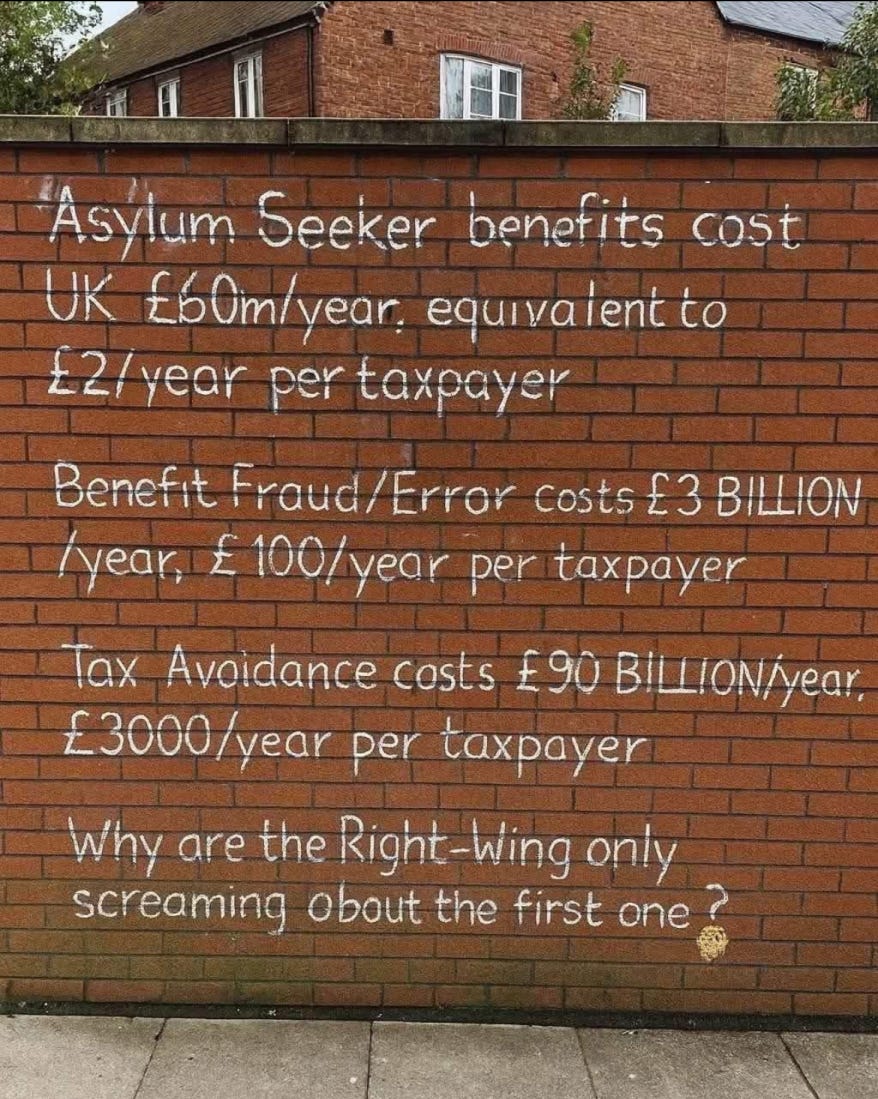
I have a folder of memes I’ve collected. Hundreds of them.
Some have made me laugh, some have made me think, and some - I’m admitting this now - I’ve shared in passing because they confirmed a feeling I already had.
One of those is the meme above.
Three claims, neatly arranged:
• Asylum seeker benefits cost the UK £60 million a year, equivalent to £2 per taxpayer.
• Benefit fraud costs £3 billion, equivalent to £100 per taxpayer.
• Tax avoidance costs £90 billion, equivalent to £3,000 per taxpayer.
Then the rhetorical kick: “Why are the Right-Wing only screaming about the first one?”
It pointed in a direction I broadly agree with - that the political and media attention paid to asylum costs is wildly disproportionate to their fiscal scale - and the numbers felt about right, or at least the kind of right that doesn’t bear close inspection if it confirms what you already think.
I checked it.
The numbers
Four minutes with Claude and a careful prompt. All three figures are wrong and they’re wrong in the directions the argument needs them to be.
The asylum claim: £60 million a year, £2 per taxpayer. The reality: The Home Office spent £4 billion on asylum support in 2024/25. That’s about £105 per taxpayer.
The benefit fraud claim: £3 billion, £100 per taxpayer. The reality: Benefit fraud and error came to £9.5 billion in 2024/25.
The tax avoidance claim: £90 billion, £3,000 per taxpayer. The reality: The total UK tax gap - the entire leakage, evasion, avoidance, plus errors plus criminal attacks - was around £47 billion. Pure avoidance was a much smaller slice of that.
The meme had also assumed 30 million taxpayers when there are nearly 39 million, which corrupts the per-taxpayer maths in every line.
Each number was wrong in the direction the rhetorical move required.
The asylum figure had to look trivial; it was minimised by a factor of seventy. The tax avoidance figure had to look enormous; it was inflated by something like a factor of fifty if you compare like with like. The benefit fraud figure sits in the middle, downplayed by roughly two-thirds, presumably because acknowledging its full size would have complicated the story.
The temptation
The instinctive response, once you’ve done the work, is to make a better meme.
Real numbers this time. £4 billion asylum, £9.5 billion benefit fraud, £47 billion tax gap. Still a striking comparison - the fiscal scale of tax-gap leakage is roughly twelve times asylum spending. Same rhetorical structure, honest figures. Why not?
This is where I had to think harder than I expected to.
The AI era has genuinely changed the moral economy of this kind of communication. Twenty years ago, the cost of verifying a meme like that was an evening in a library, and probably still ending up uncertain because the underlying definitions are slippery. Today it’s four minutes and a careful prompt.
The old excuse - “I can’t reasonably be expected to verify everything I see” - has weakened a lot. If you can verify it and the verification supports a version of your point, then making the verified version isn’t fighting fire with fire. It’s just bringing better fuel to the same fire. That’s the steelman of the case for doing it and I want to give it its full weight before saying why I think it still doesn’t work.
When the lying is load-bearing
I was almost convinced. Then I tried to write the honest version of the meme.
It didn’t function. Not because the numbers don’t support an argument - they do - but because the framing of the original couldn’t survive them. “Why are the Right-Wing only screaming about the first one?” assumes the first one is trivial. Once the first number is £4 billion and growing, that framing collapses.
Someone could reasonably care about £4 billion of public spending without being a fool. Someone could reasonably care about £9.5 billion of benefit leakage without being a fool. Someone could reasonably care about a £47 billion tax gap without being a fool.
The framing of the original meme - that one of these concerns is bad faith and the others are virtuous - only works if you’ve already lied about the scale.
The lying wasn’t decoration. It was load-bearing.
You can keep the real numbers and drop the contempt. The meme then becomes: “the fiscal scale of tax-gap leakage is several times larger than asylum spending yet attracts a fraction of the political attention.”
That’s a defensible observation. It’s also a different and much quieter argument than the one I would have been making by sharing the original. It doesn’t accuse anyone of stupidity. It doesn’t reward the viewer with a dopamine hit of in-group righteousness. It’s more interesting and less satisfying and it would never have travelled the way the original did.
The genre, not the politics
Sitting with that, I started to recognise the pattern across other memes I’d shared and across memes that had bothered me equally from the other political direction.
There’s a genre and it works the same way regardless of where it points. It identifies an out-group - the duped, the foolish, the screaming - and flatters the viewer as the one who sees through them. It compresses a contested empirical question into a single arresting comparison. It rewards reflex over reflection.
The political content varies. The cognitive shape is identical.
There’s a Patrick Bateman meme that floats around saying the mouse dies in the mousetrap because it doesn’t understand why the cheese is free. Same structure.

There’s a Sarah Connor meme captioned “watching you use AI for everything.” Same structure.
There’s the asylum meme. Same structure.
The form is what’s doing the work, not the content. The form trains its audience to think in slogans, to identify enemies before issues and to mistake confidence for accuracy. That’s not a left or right problem. It’s a problem with the medium and joining in from any direction makes it worse.
What Brexit actually taught us
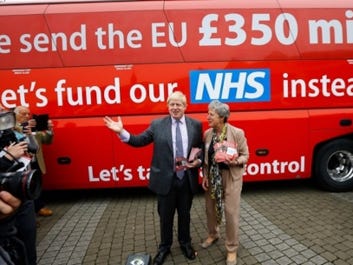
The Brexit referendum is the obvious test case. Leave’s claims were memorably manipulated. £350 million a week for the NHS. Turkey is joining tomorrow.
Remain’s response was patrician and dull and many on the Remain side concluded that the lesson was to be punchier next time, more like the other lot. Some of those memes happened. They didn’t work. They mostly gave Leave permission to call Remain liars too, after which the persuadable middle decided everyone was lying and went with the side that felt more like them.
What did work, slowly, was the patient accumulation of reality.
Trade statistics. Northern Ireland politics. EU staff leaving. Capital reallocating. Customs queues. Journalists named what was happening as it happened. Businesses described the costs in detail. Academic economists published the numbers.
None of it was viral. Most of it was boring. All of it compounded.
Brexit voters are now telling pollsters they were misled. Not because anyone made a clever counter-meme. Reality came in and there was a parallel infrastructure of honest naming that allowed the realisation to settle.
If both sides had been making things up, that infrastructure wouldn’t have existed. The reckoning would have been impossible, because there’d be no stable reference point against which to discover you’d been deceived.
The honest position is what makes the eventual correction possible. It’s the long-term reservoir of credibility from which the truth gets drawn. Burn it for a short-term gain and the next round of lies meets no opposing pressure at all.
The hardest part of the argument
In the short term, while reality is catching up, people suffer.
Asylum seekers are suffering now because the discourse around them has been deliberately poisoned. Brexit has cost real money to real people. “We kept our integrity” is small comfort to someone whose life has been made materially worse.
The moral seriousness of the fight-fire-with-fire instinct isn’t a weakness in it. It’s the part that matters most.
I don’t think the answer is to wait. I think the answer is that the work which actually compresses the timeline isn’t counter-memes. It’s everything else and the everything else is more leveraged than it looks.
Alternative media infrastructure that doesn’t depend on the gatekeepers. The Rest is Politics, Tortoise, Byline Times, the better Substacks, local journalism that survives because its readers value it. A thousand small craftspeople doing careful work, with enough audience overlap that ideas travel between them. Individually small. Collectively, over a decade, this has changed what the persuadable middle considers a serious source.
Structural reform of media ownership, which the political class has consistently refused to attempt. Leveson II was killed for a reason and the reason is that the people who killed it benefit from the system as it stands. There’s a live argument about ownership transparency, foreign ownership rules, cross-media limits and BBC defence that needs more energetic constituency than it currently has.
Media literacy at scale. Finland has been teaching this in primary schools for years and consistently shows up at the top of European resilience-to-disinformation surveys. People who have been taught to ask “who benefits from me believing this and how do I check?” are an order of magnitude more resistant to manipulation than people who haven’t. That habit is teachable.
Deep canvassing. The research on persuasion in genuinely contested political conversations is pretty consistent: long, honest, two-way conversations between people who actually know each other change minds. National counter-messaging mostly doesn’t.
The implication is uncomfortable for anyone who likes the leverage of writing. The conversations you have with the colleague in the warehouse, the parent at the school gate, the customer over coffee, are weight-for-weight more politically consequential than the post that reaches a thousand strangers who already agree with you. Both matter. The local conversation is the one that shifts the persuadable.
The slow building of trust-nodes within communities. When the local doctor says something, that beats the Mail, when a business owner says something, that beats Twitter, the discipline of using that credibility honestly - not to deliver political opinions you happen to hold, but to model careful thinking out loud, to show what it looks like to actually check something, to disagree with people of your own tribe when they’re wrong - is a form of public good that scales in ways no metric captures.
Trustworthy nodes are what an honest information environment is made of.
You can’t fix a corrupted information environment by adding more corrupted information, even when yours is corrupted in a better cause. You have to work on the system.
That work is slower and less satisfying and feels like losing on most days. It’s the only work that compounds and the work that doesn’t trade your tomorrow for your today.
The hairdresser
A small note to end on, because none of this should mean joylessness.
The other day, I walked past a hairdresser in Shrewsbury and stopped to photograph the chalkboard outside. White handwriting on black, slightly misspelt, with a little drawing of scissors at the bottom.
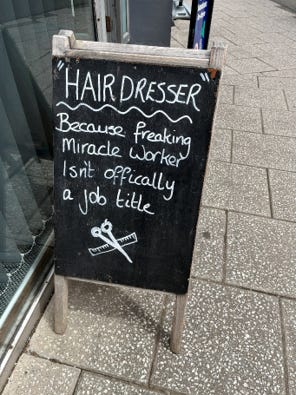
“HAIRDRESSER” Because freaking miracle worker isn’t officially a job title.
That’s a meme too, in the original sense of the word. Compressed wisdom designed to travel, delivered with humour.
It’s the opposite of every meme I’ve been writing about. There’s no out-group. No contempt. No flattering the viewer at someone else’s expense. No load-bearing falsehood.
It’s a person standing behind a craft they’re proud of, making you smile as you walk past and inviting you in if you fancy a haircut. The signs of authenticity are everywhere - the handwriting, the typo nobody bothered to correct, the local placement, the face behind it.
The discipline isn’t to be against compressed communication. Compressed communication is most of what humans do and a lot of it is wonderful.
The discipline is to know the difference between the genre that compounds and the genre that depletes. The hairdresser's sign compounds. The asylum meme depletes.
Learning to tell which is which, in your own sharing as much as in what comes at you, is the work.
What I do now
The answer to the question - what do I do about a meme I shared in good faith, now that the cost of checking has collapsed - is something like this.
I check first.
I sit with the result. I notice whether the framing requires the lying to function. If it does, I let it go.
If the honest version is quieter and less satisfying, I sometimes make the quieter version anyway and accept that it won’t travel as fast as the original would have. If possible, I try to have the actual conversation with the poster, often to limited avail. I save room for the hairdresser's signs.
I trust, on the available evidence, that the long arc does bend - not by itself but because there are enough people patiently pulling on it and because of Brexit, I’ve become friends with a decent number of them. The Brexit reckoning is real. Denmark has reversed course on classroom screens because the data came in and the country had the institutional confidence to admit the experiment hadn’t worked. Local journalism is finding new models. The hairdresser is still freaking miracle-working.
The work is possible, the people doing it are real and being one of them is more fulfilling than being good at memes.
Not faster. Just truer.